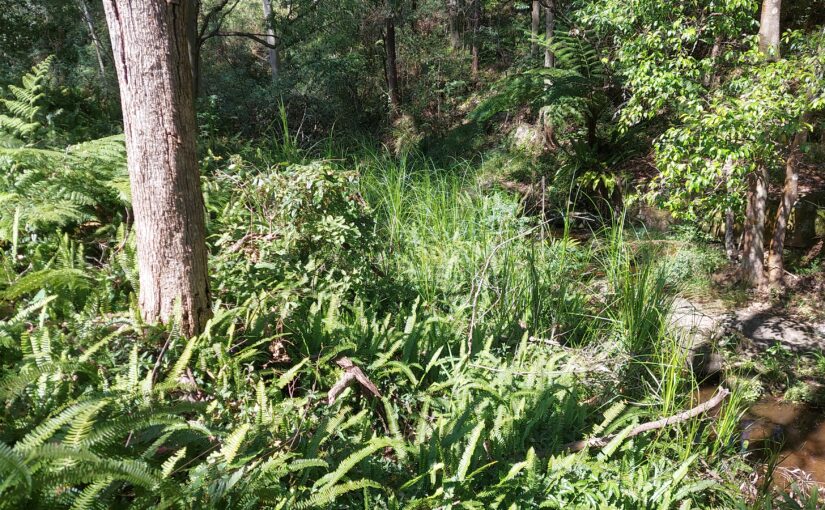
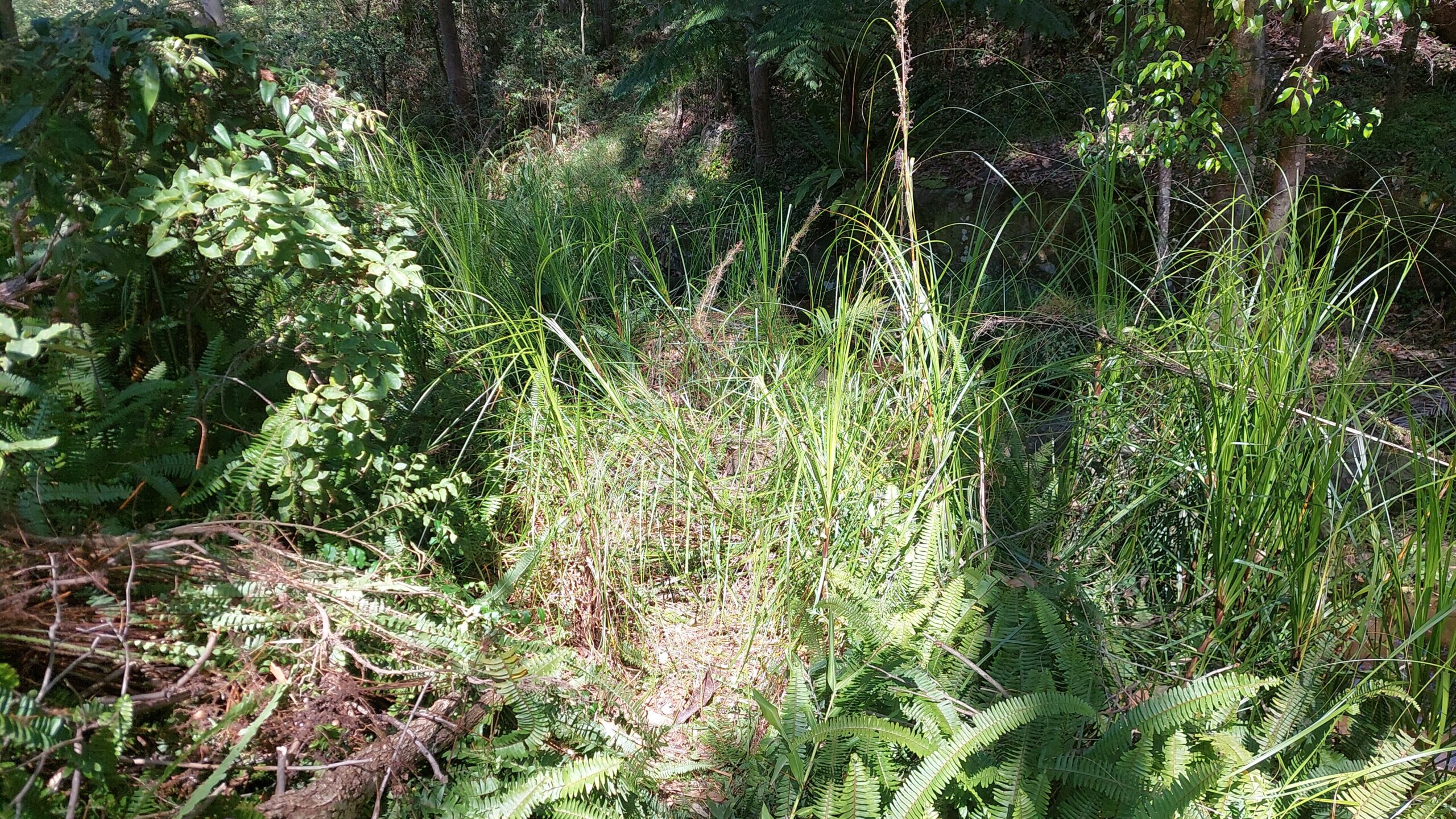
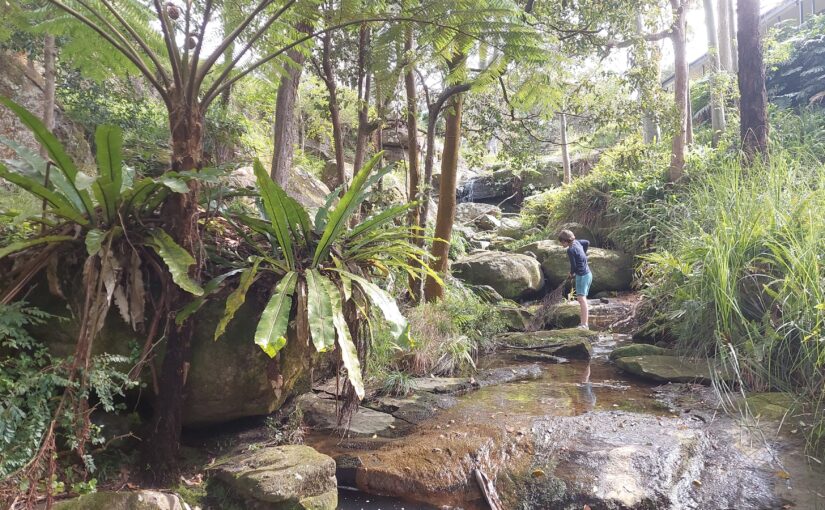
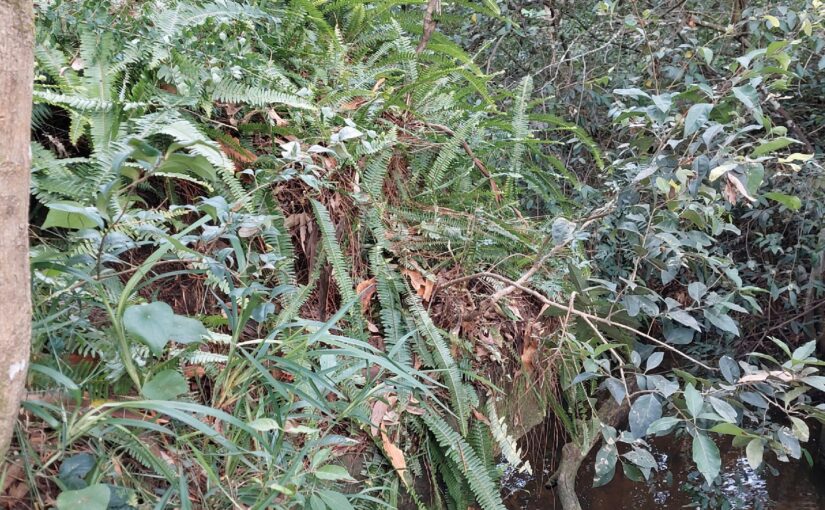
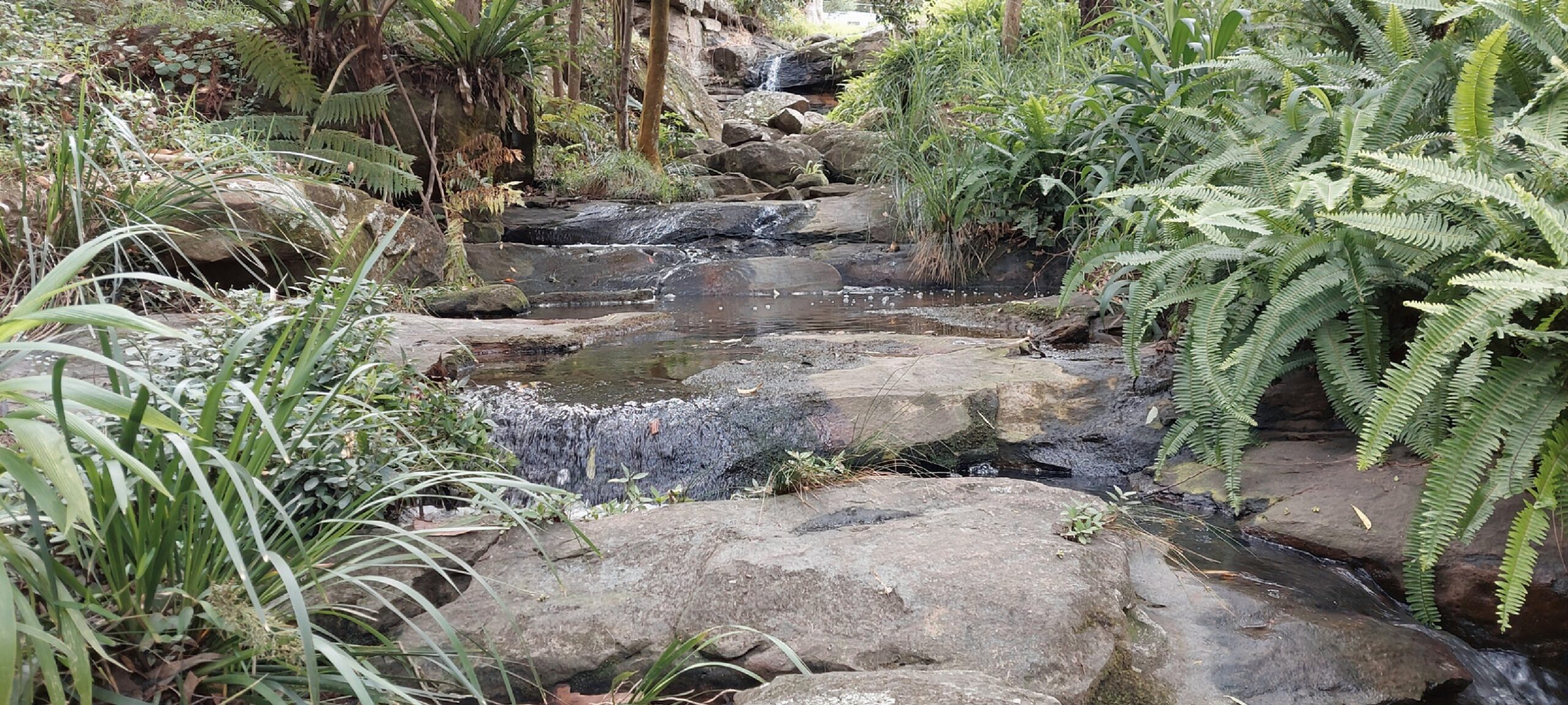
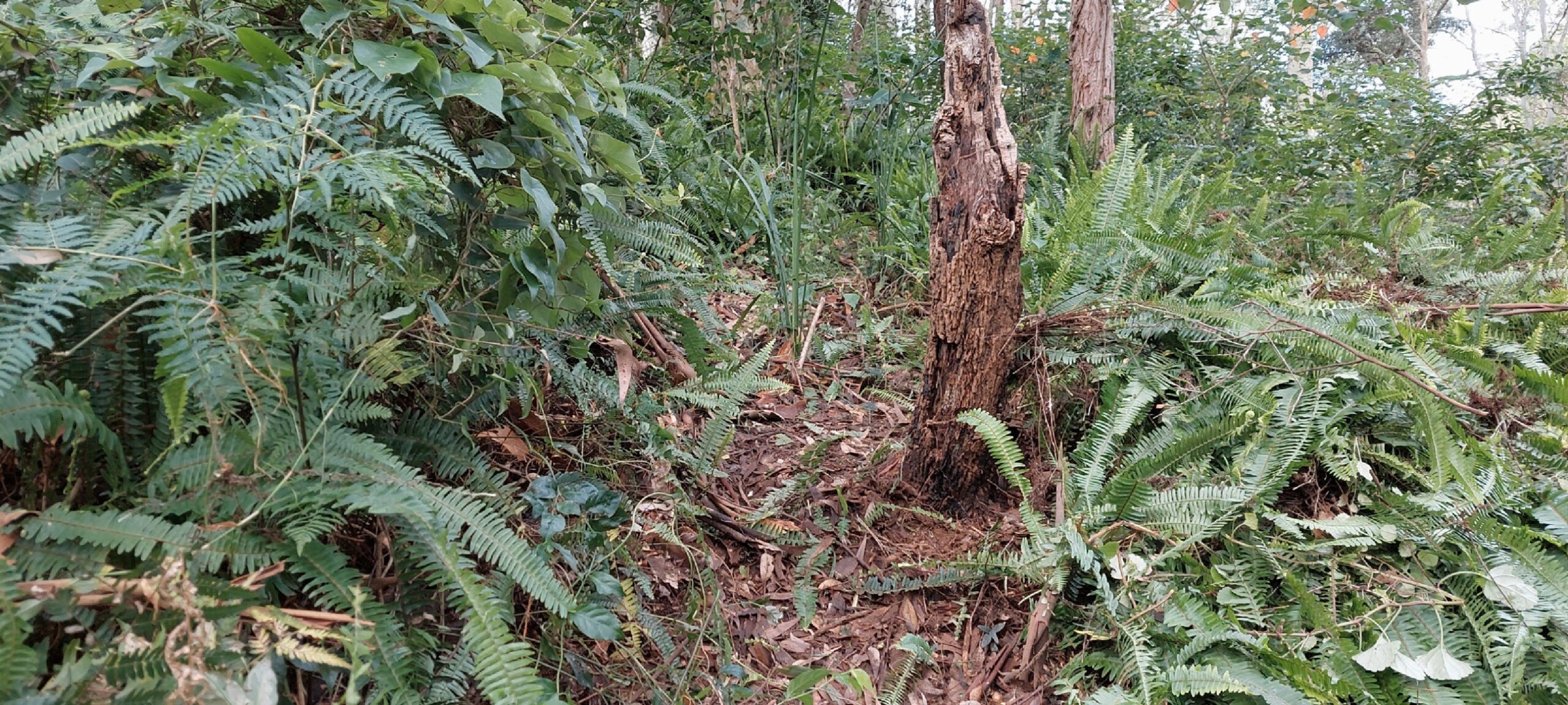
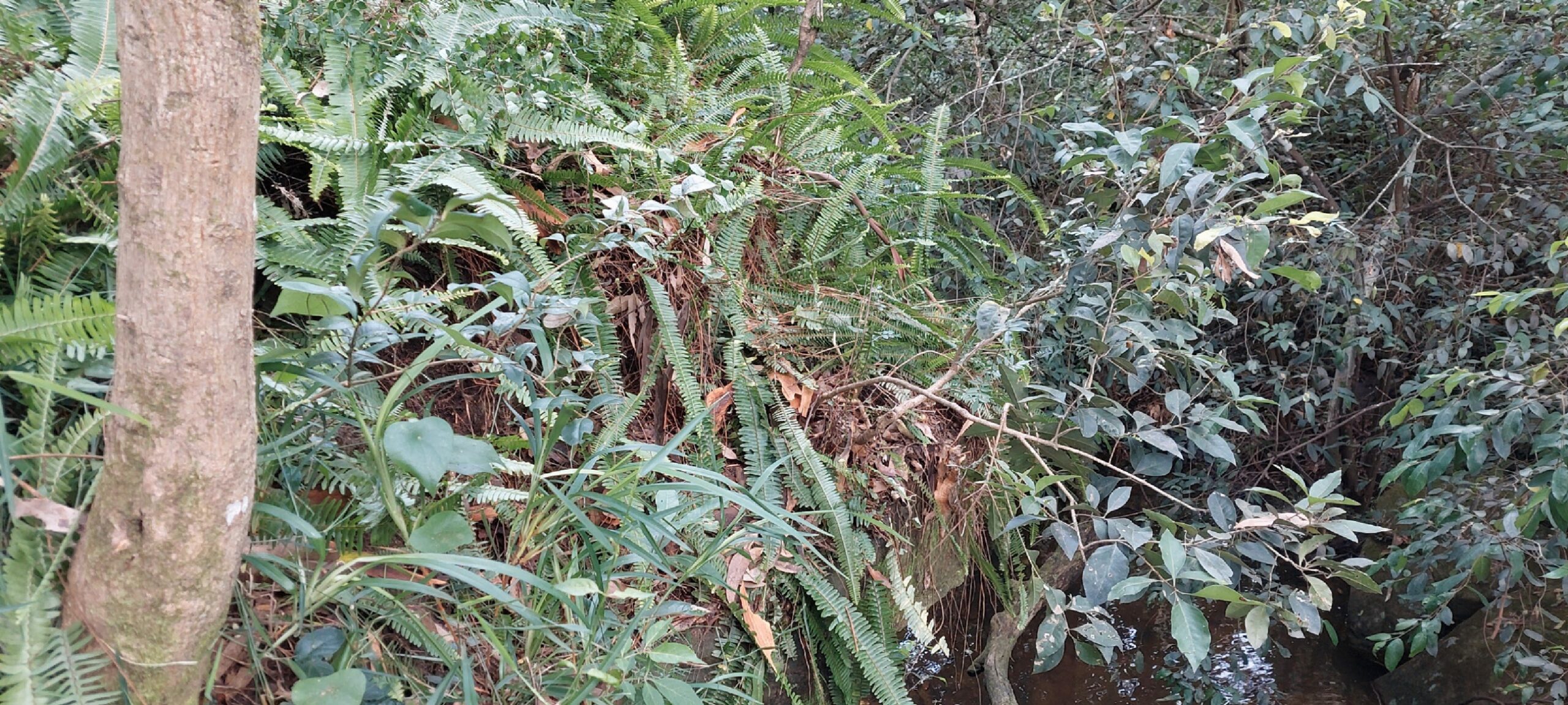
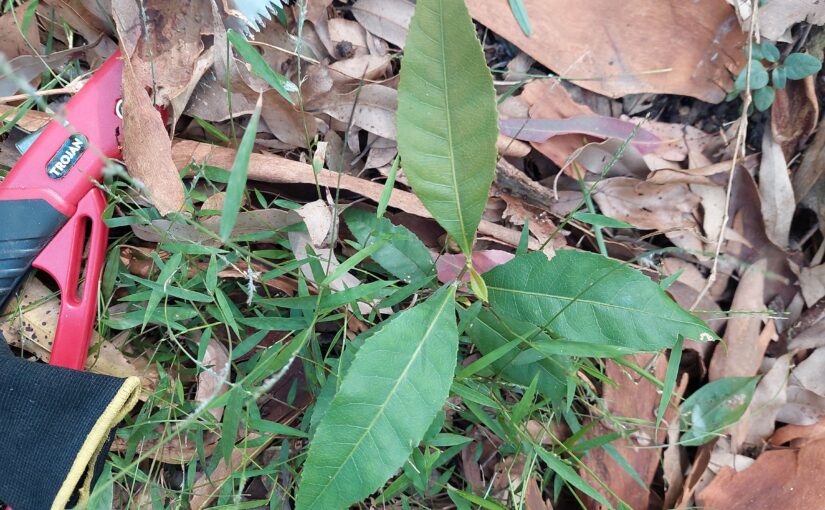
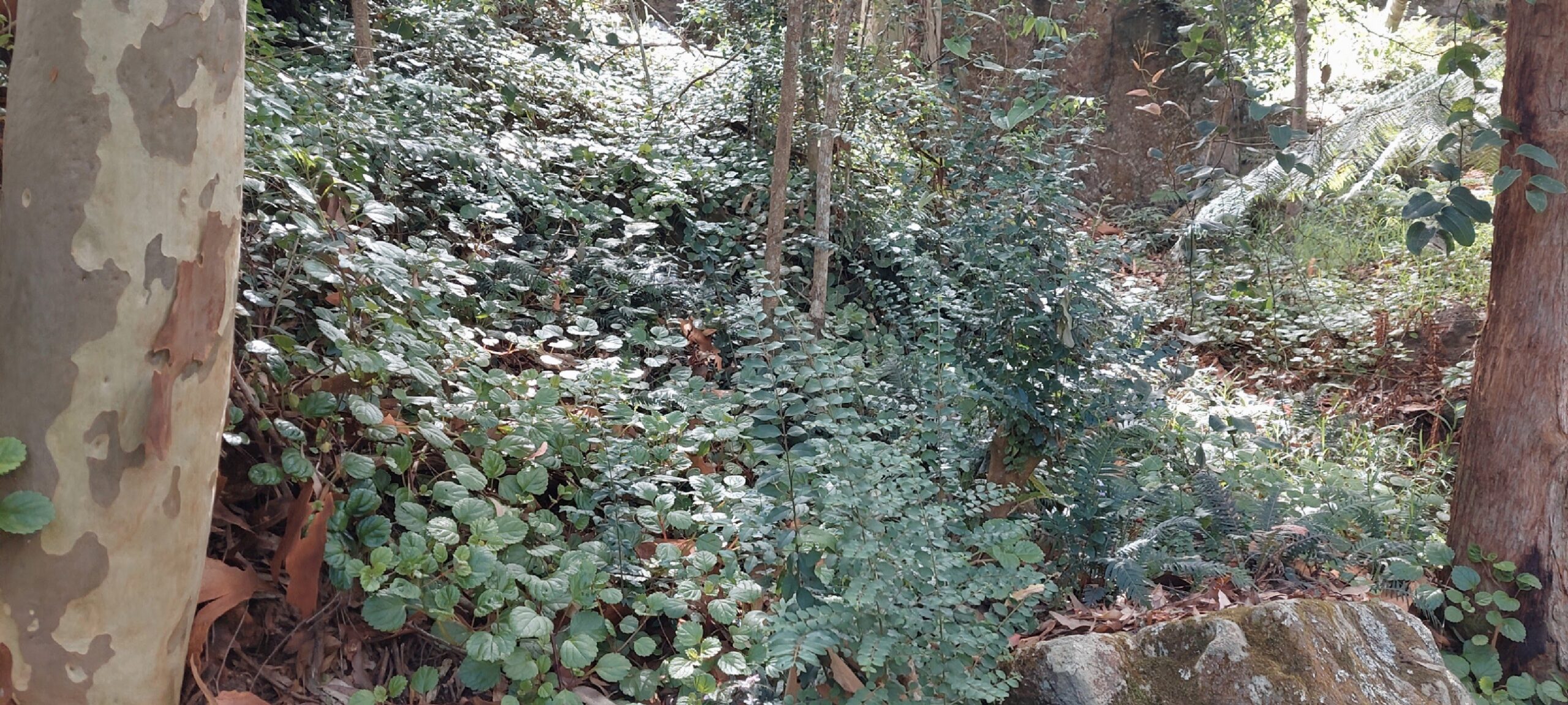
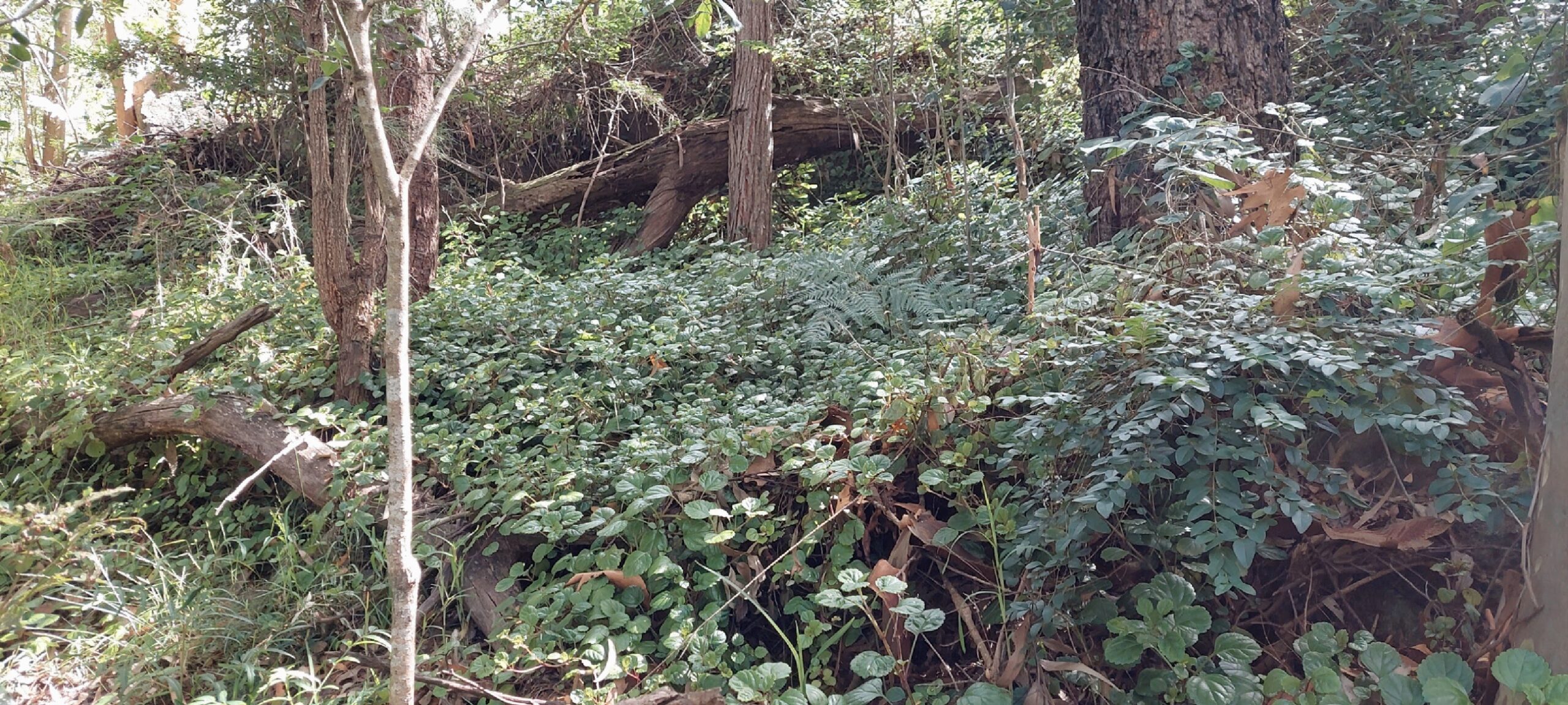
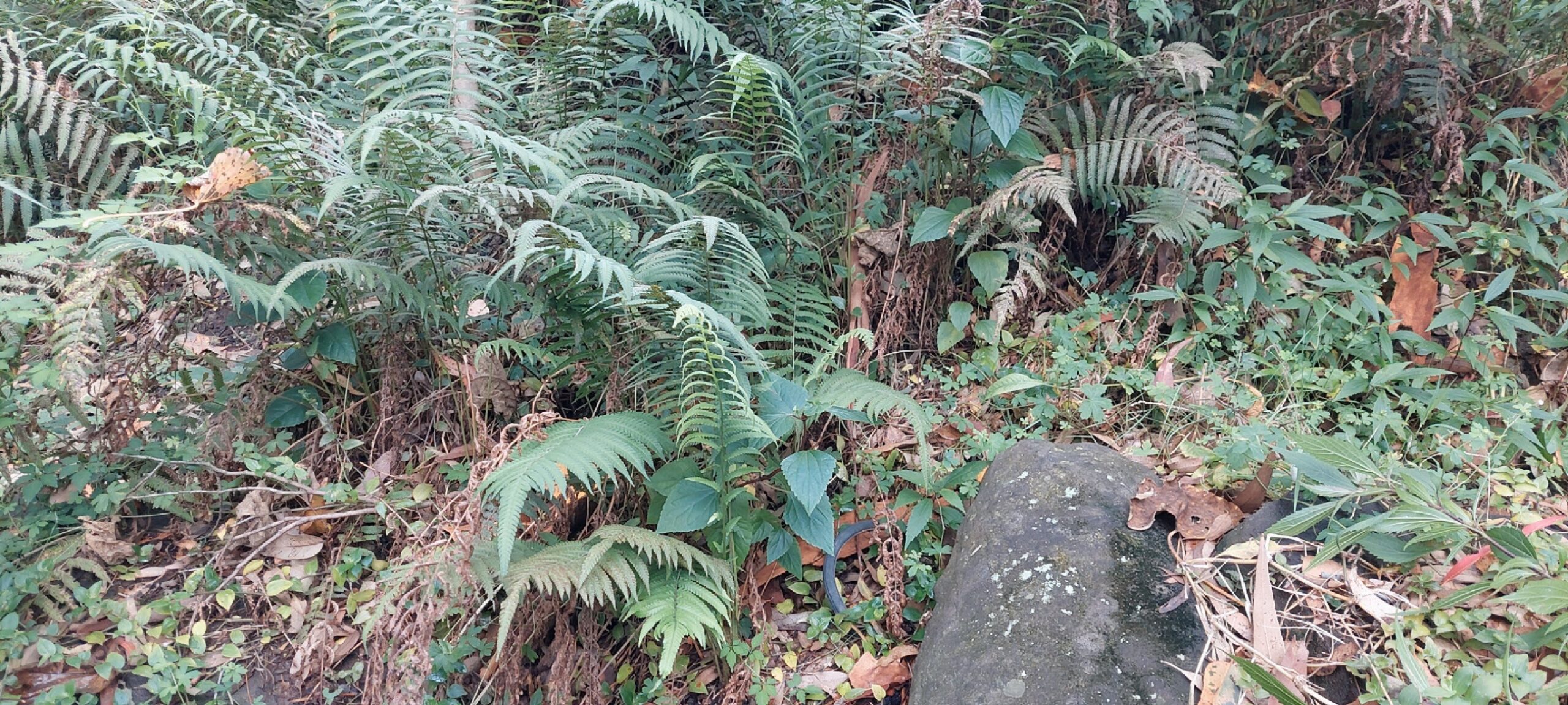
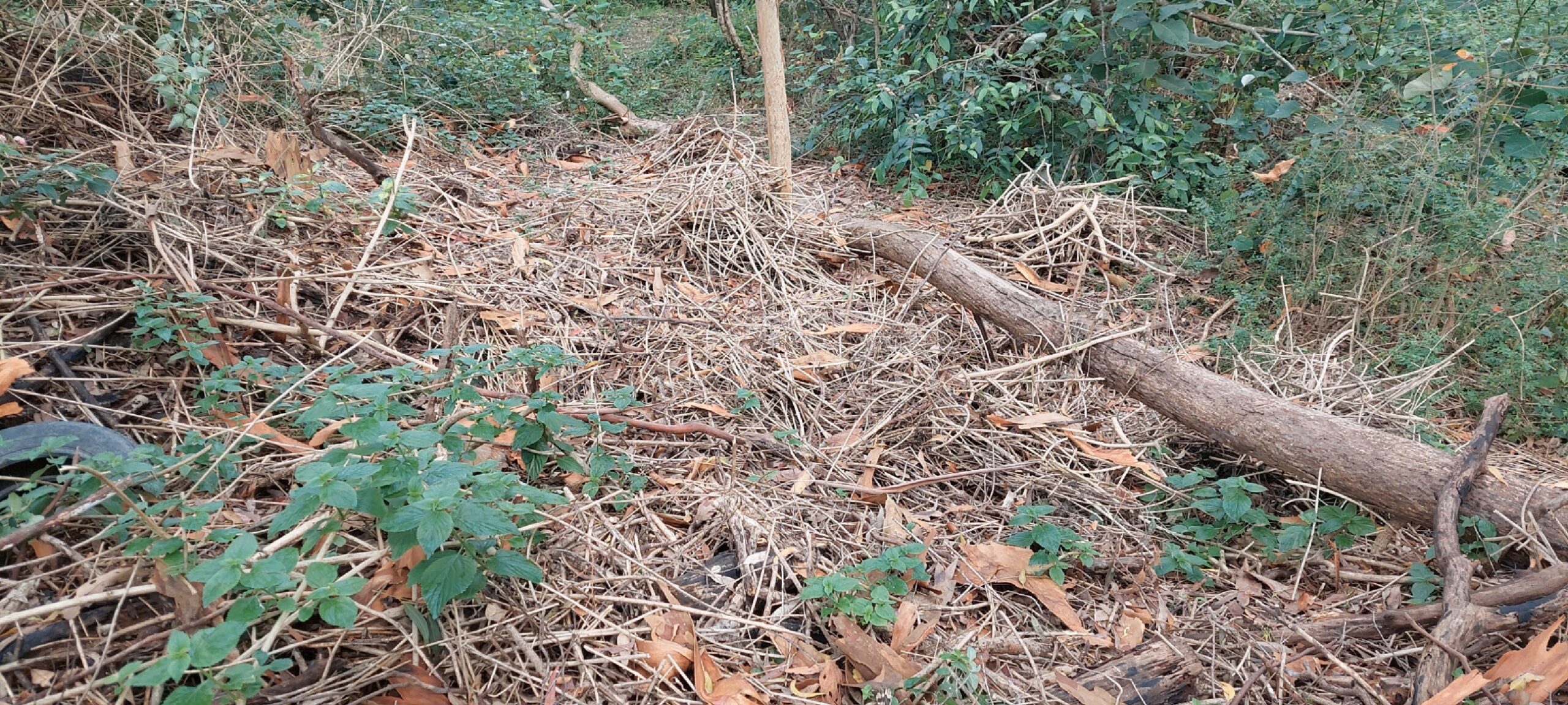
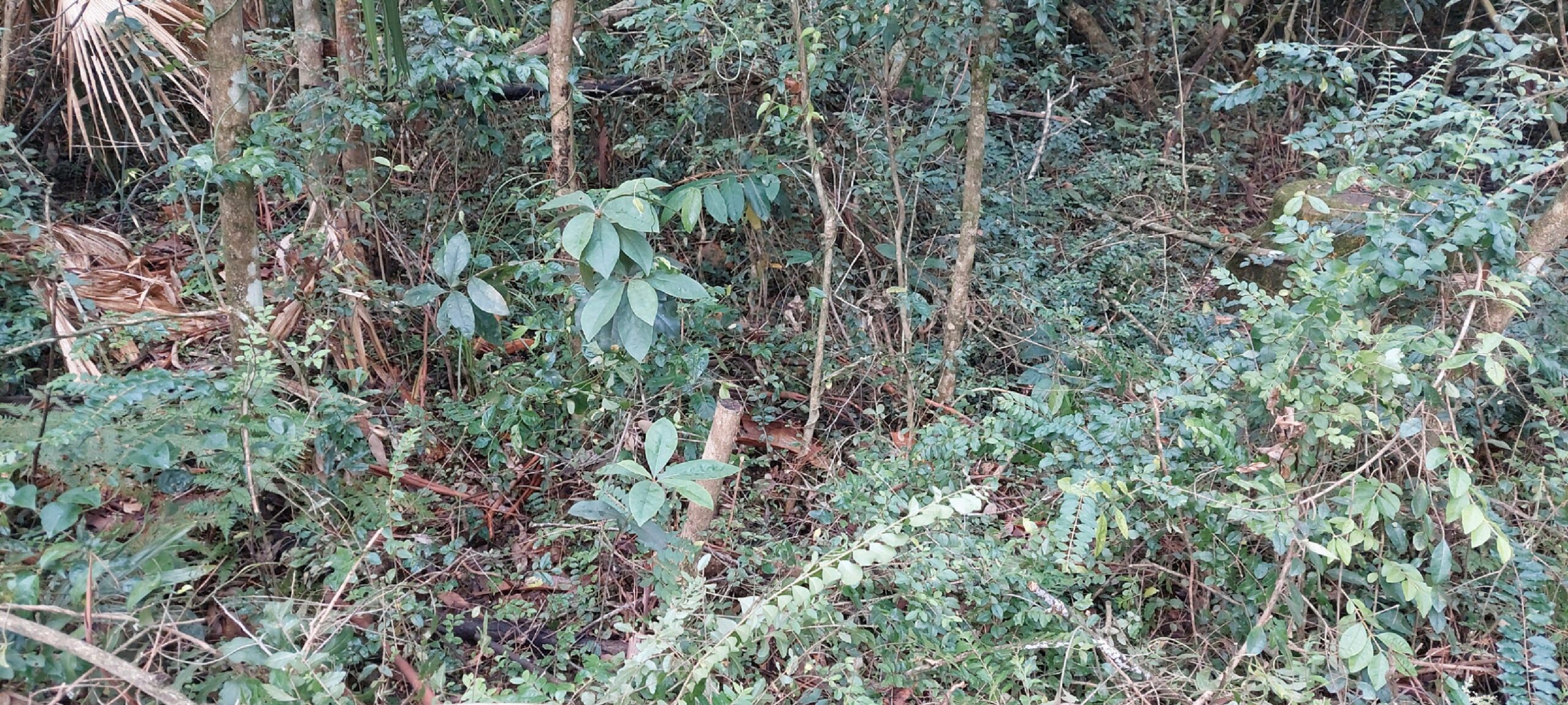
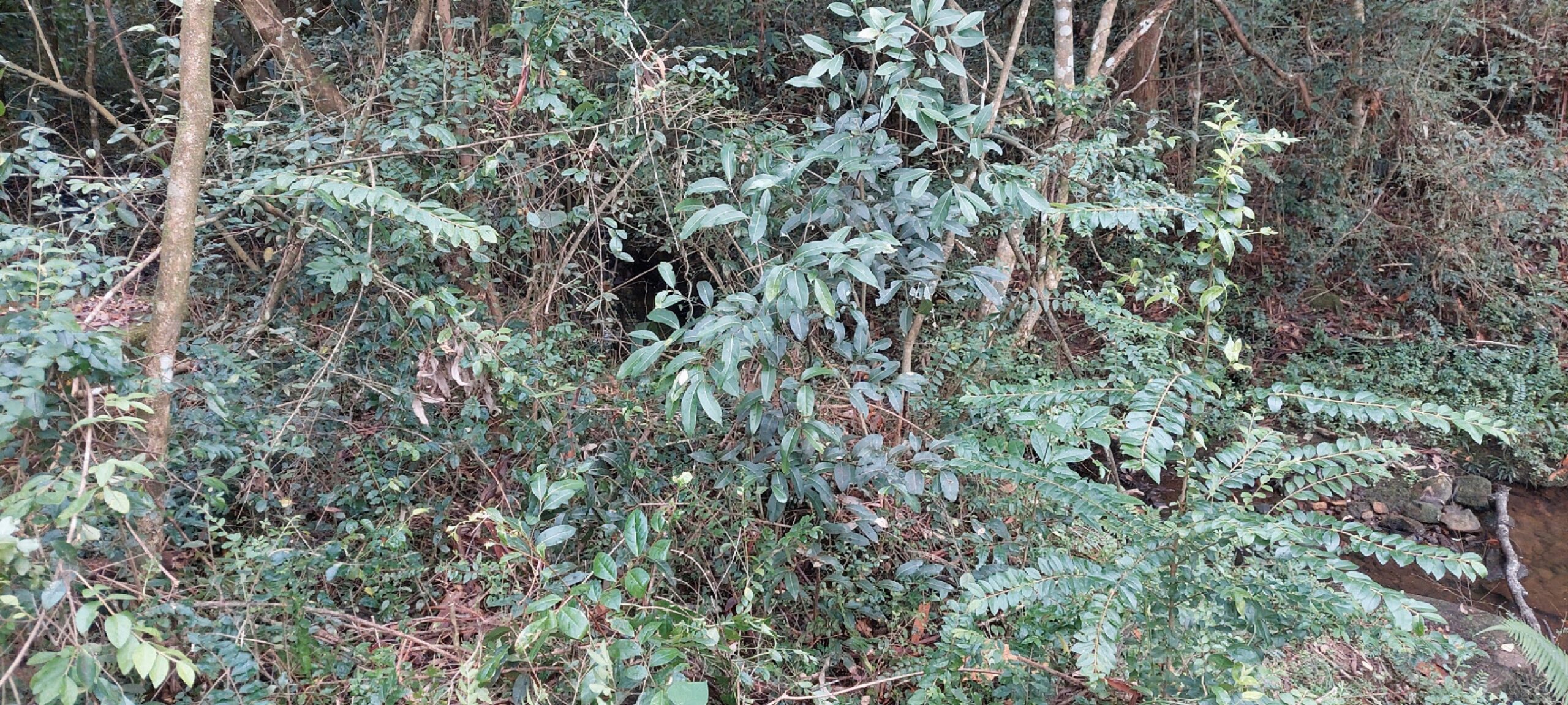
Between first and second falls, across from fern wall is a section covered in saw sedge (Gahnia sp. ).
Stand of saw sedge on north bank between first and second falls
I have been very happy with this section as I had previously thinned out the fishbone fern in the past and the sedge has gone strong since. Still, even from a distance I noticed the fishbone fern making a comeback and on closer inspection it was worse than I thought. The mature sedge is doing well but the fishbone fern was clearly dense enough to hinder new growth.
Fishbone fern is easy to remove but in this case I had to move relatively slowly as to not damage the sedge in the process. It ended up taking a few hours but I feel the result was worth it.
I was also able to maneuver the weed puller between the sedge to allow removal of a small privet tree which was growing from a stump.
Same area minus a bunch of fishbone fern
It is going to be interesting to watch this area over the next few months. Hopefully the sedge will beat the fishbone fern into those spots that are now free.
Another working bee completed last Saturday. I had mist flower going strong on the South bank after first falls. It is very easy to spot when it is flowering and unfortunately, it has been prolific.
Disappointingly, by the time I got to the area, I could see a lot of the flowers had gone to seed. Basically it means I will be faced with the same issue next year. Because mist flower tends to break off easily, it can be difficult to get enough of the plant to ensure it won’t grow back. I believe I got most of it at ground level but I have the problem of accessibility with the plants at the top of the cliff. The edge of the cliff is sloped at the top so it becomes risky trying to reach it from the top but the cliff is a bit too high to easily reach from the bottom. I have left the plants on the cliff for a time when I have some equipment to help reach that section.
In the same area I also removed the croften weed, fishbone fern, palm grass and any other unwanted species in the area. I also tried to poison the privet tree that is growing strong at that spot. I am writing this a week after the working bee and I don’t see any effects on the tree so I am beginning to think I went to easy on it.
It was disappointing to leave so much mist flower behind but it won’t be forgotten. It’s time is limited.
As a whole, this area is not doing too badly. Most of the ground is covered in native ferns and a number of trees have sprung up naturally and are going strong. There Bleeding hearts, sandpaper figs, and a red cedar all going strong.
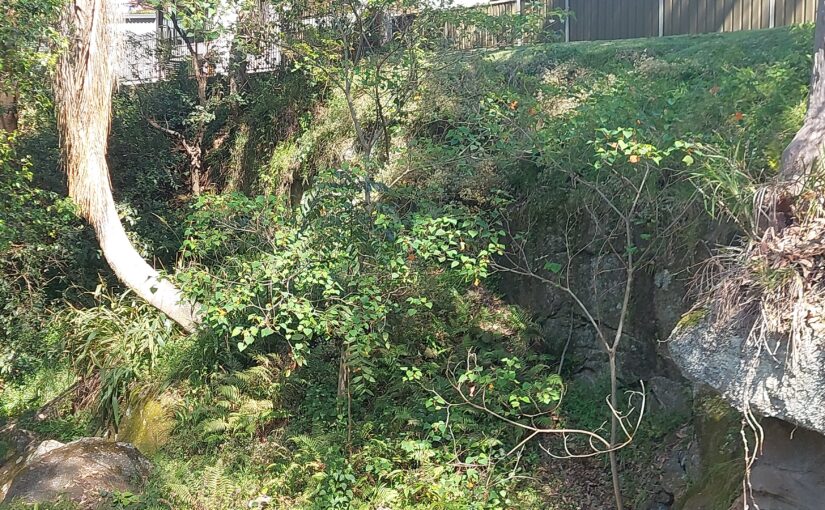
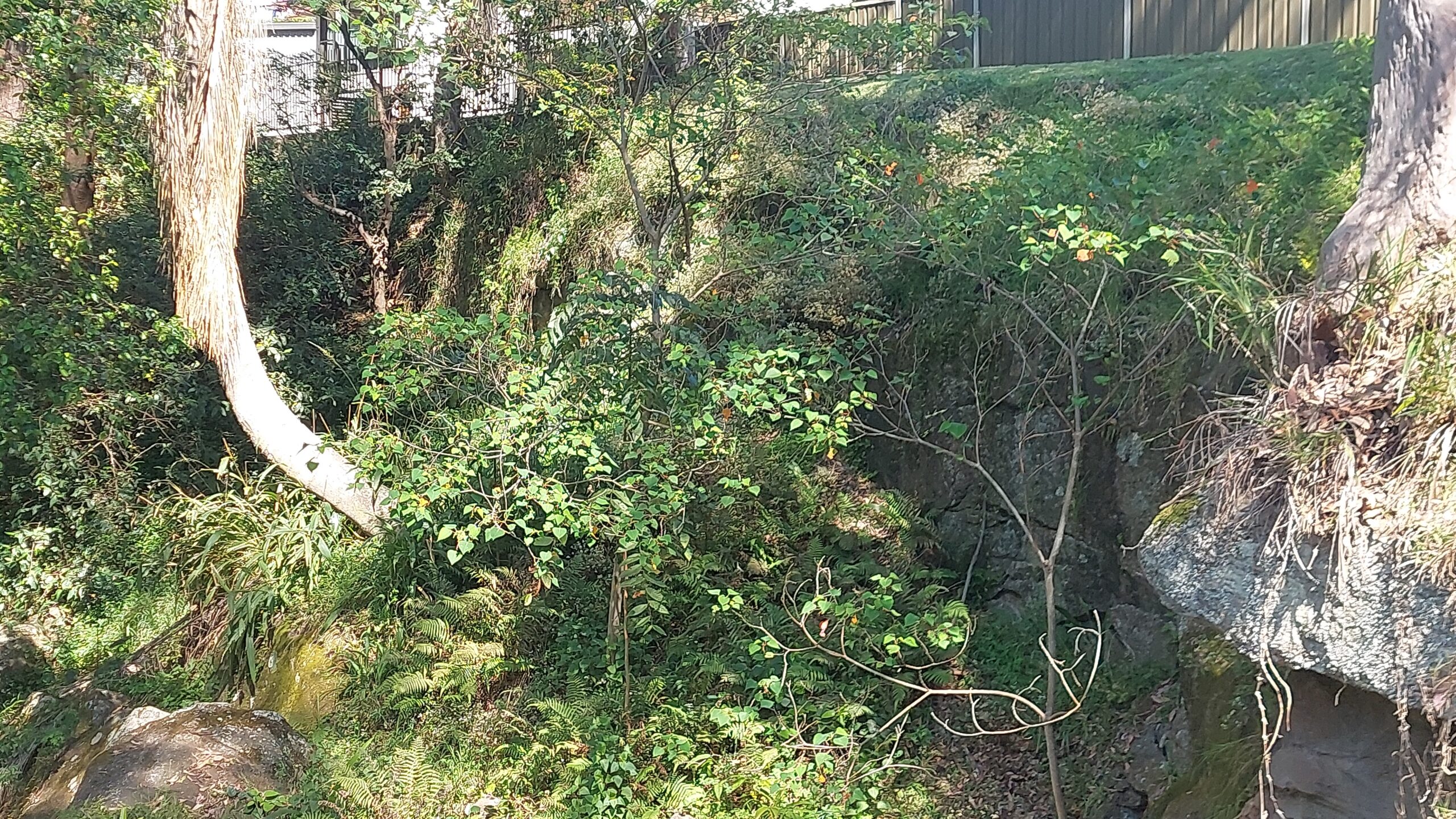
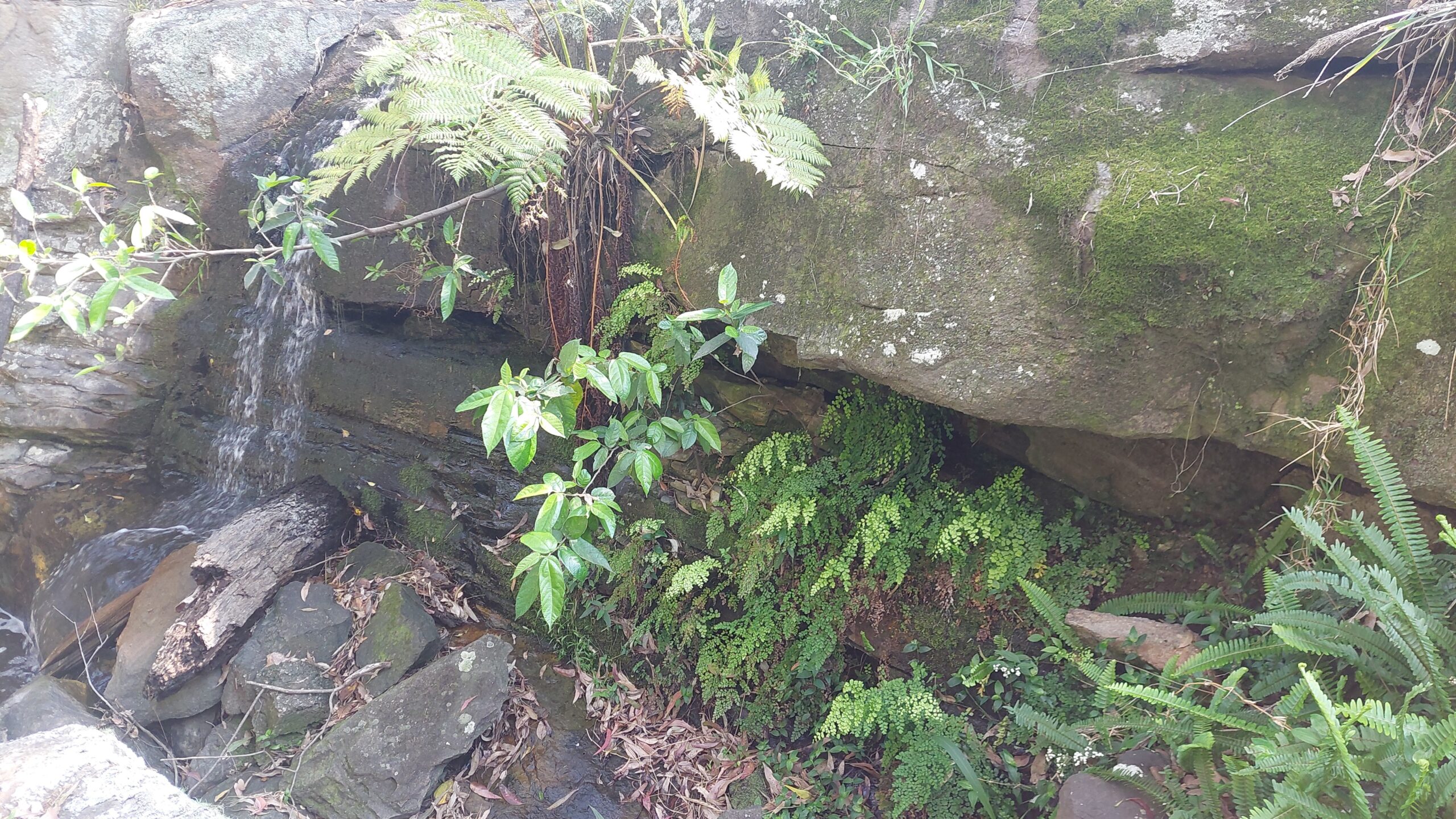
Another positive note, the plants growing on the cliff face to the side of first falls is currently looking great.
Cliff face at first fall
There are a few sandpaper figs growing from the cliff face as well as a tree fern on an abundance of maiden hair fern. It all looks quite healthy at present.
This is certainly the time of year for Bush regeneration. Good temperatures and soft soil make pulling out invasive weeds so much easier.
My intention was to get to the Bracken fern mound, close to the Sandpaper fig tree I cleared around last week. To do so though, I had to go through Site A and I really could not walk past it while it was in the state it was in.
While fishbone fern dominates this area, it is the privet that concerned me. Fishbone fern is easy to deal with while privet can develop deep roots which can result in a lot more work to remove them and they are well able to push out most other vegetation, especially when combined with lantana.
This is site A. It was once thick with lantana and then it was host to many bleeding heart trees. At present it has more fishbone fern than anything else.
This next photo shows site A after removing most of the privet and lantana along the back bank of site A. It is hard to see any improvement as there is still a wall of privet at the back of the area.
I did free some dianella of fishbone fern, seen here on the right, but for the most part, the fishbone fern has to wait for another day
I cleared site A of lantana and privet and then continued to do the same thing along the bank, past site A. The photo below is me looking back towards site A after finishing up for the day.
I was very happy to see this Poison peach tree (center of image) at the end of the day. I had seen this tree as a young sappling not long after doing some bush regen in the area. I would say it is now fully grown, standing around 5m tall. It joins my list of things to do as I see the lantana has started to encroach on it.
I was happy to find this poison peach tree at the end of the day.
There were a few mystery plants I came across during the day. One vine was identified by a facebook group. Mystery plant – Clematis aristata
Perfect weather to do some bush regeneration yesterday.
No rain but the ground has had a good soaking so the weeds couldn’t put up much of a fight when being pulled out.
From my last few visits, I knew a lot more work was required to recover from the neglect of the last few years.
First step: An action plan. I moved around the reserve and tried to list the sections that required attention.
This stand of ginger lilly and palm grass continues to grow. It needs to be controlled while a native such as native ginger is allowed planted and encouraged.
Stand of ginger lilly and palm grass
These Sydney golden wattles were planted only four or five years ago but currently appear to be struggling or dead.
Though it is hard to see in this photo, there around about eight Cheese trees which were planted a few years ago.
They appear healthy but are clearly failing to make progress against the heavy clay soil.
I still hold hope that some of them will find a way to expand their roots to allow more growth.
The grass needs to be removed or thinned to allow new growth to have a chance.
Cheese trees and Sydney golden wattle are struggling
First falls is going well. A tree fern and some sandpaper figs are now growing out of the cliff face.
Dick’s creek first fall. Showing the tree fern and sandpaper fig growing out of the cliff face.
On the south bank, besides first fall, there is some clean up to be done. Fishbone fern is starting to appear, croften weed is still popping up and the privet tree has bounced back.
Still, it is mostly in good nick. An hour or so of work should have this area back in good order.
South bank besides the bottom of first fall.
On the south bank, just before the Fern wall, a section of bank is soil rather than the usual rock.
Palm grass has taken hold and needs to be addressed. This is true for the entire creek. I imagine an entire day will need to be
devoted to removing palm grass.
South bank besides First and Second falls
As a whole though, the section of creek between first and second falls is not all bad.
A lot of endemic ferns are going well, the Gahnia on the north bank is more established than ever and most of the visible trees
are meant to be there. The issues are the palm grass, the swedish ivy and the fishbone fern. Each of these will take quite some time to address
Creek course between First and Second falls
South bank between first and second falls. Fern wall to the left of the image.
North bank between First and second falls
Fern wall, on the south bank between the first and second falls looks good but some bird nest ferns have gone ‘missing’.
We have had people steal bird nest ferns in the past and I suspect it has happened again. I can’t be sure until I locate previous images.
The ferns that are still there are going spectactular. The tree fern has shot up, as have other tree ferns at other locations.
Conditions must of been just right for this species.
Fern wall on south bank between first and second falls
Creek course from top of second fall
Besides Fern wall though is the swedish ivy that is yet to be removed. Areas that have been done are still clear though so that is a good
sign that it can be fully removed.
South bank between first and second falls. Besides Fern wall
South bank besides second falls
At the top of Second fall, things look mostly ok. There is still privot, palm grass and fishbone fern to address but
it is good to see the weeds have not jumped back quickly into this area.
Lower level from the top of second fall
Fishbone fern is once again dominating the ledge on the north side of Second fall.
Luckily, the natives have a longer reach than the fishbone fern so are still able to catch the light they need.
North side ledge at Second falls
Cabbage tree palm is looking good after some shading trees were removed from a nearby property.
Cabbage tree palm near site A
Site A is still clear of lantana but is now covered in fishbone fern. Disappointingly,
something laid waste to the stand of bleeding hearts which were growing here. There is still a few but most are now dead.
Site A, behind 14 Green Valley Rd
This bank has always been dominated by fishbone fern but it has currently taken it up a notch
now that it is getting so much more light with the removal of some large trees at the top of the bank.
Hill above Site A
Simlarly for the bank behind 16 Green Valley Rd.
Hill above site A upto 16 Green Valley Rd
This photo shows some of the bleeding hearts that have been pushed over. Hopefully more will grow
when the fishbone fern is removed.
What was bleeding heart forest
From site A, looking towards the creek at the rear of the reserve, it appears as if privet has taken over. Hopefully it is
not as bad as it looks…
From site A, looking down to the rear of Dick’s creek reserve
There is a stretch of poisoned lantana at 16 Green Valley Rd. I am not sure what the purpose is.
Lantana behind the properties on Green valley Rd
This area is kept clear by the property owners above.
Hill leading up to properties on Green Valley Road
Fern trees along the back of the reserve look to be doing well. However, the lower storey is once again dominated by undesireables such as lantana and ginger lilly.
Fern trees along the read of Dick’s creek reserve
Lots of privet in this area towards the creek as well.
Cleared strip of land to the creek near rear of reserve
A stretch of land is kept clear down to the creek by the property owner above. The land to the side of this ‘alley’ is
infested with privet and lantana.
Lantana towards rear of reserve. Creek can be seen towards the bottom
I had previously cleared around a large sandpaper fig at this location. Lantana was once
again encroaching heavily on this tree and the area in general. I needed to clear the lantana just to get to the tree so I could start
clearing around it.
Lantana and privet encroaching on sandpaper fig that was previously freed
Around three or four years ago, the sandpaper fig tree had fallen over. It was disappointing at
the time but since then, the tree has continued to thrive and is still bearing fruit. This photo shows the roots have grown to accomodate
its new position.
Roots of fallen sandpaper fig have grown to accomodate its new position
At this point I had finally reached the base of the tree. My intention was to clear the area
around the tree so I could walk freely around it, but that ended up being too ambitious as some of the privet and tobacco trees were
too big to pull out by hand.
Fallen sandpaper fig with encroaching lantana and other invasives
This photo shows new shoots rising vertically while the main trunk is now more horizontal. It looks
like this tree will be around for many years to come yet.
Fallen sandpaper fig with encroaching lantana and other invasives. Despite falling about three years ago, it remains strong and is still producing fruit
One positive discovery was finding this poison peach tree. There were also some young sapling nearby.
I was able to free them from the lantana which was starting to get on top of it. It is about three metres tall.
This poison peach tree and some younger saplings was covered in lantana. It is about three metres in height
Wile it is not clear, this photo shows the sandpaper fig tree. I was able to walk around it
(rather than climb) by the time I had finished. Some large privets had to be left for another time. I was happy with the result.
This was the sandpaper fig tree after clearing around it. It still looks chaotic but by the end it was free of lantana and privet
This shows the ‘dent’ in the wall of privet. I am mindful that any clearing like this invites foot
traffic from the kids in the neighbourhood. It will pay to start at the center of the sea of lantana near here and work towards the edges for this reason.
The area I cleared to get to the sandpaper fig tree.
Near the creek at the end of the reserve has become infested with privet but there are still
some natives doing well. For example, this cabbage tree palm…
Looking towards rear of the reserve towards the creek. Mostly privet but still some natives struggle on
A wall of privet…
On the side of the cleared strip, privet dominates.
But amongst it…
Unidentifed vine next to cleared strip. Pretty sure it is native but need it identified
Unidentifed tree – pretty sure it is native but need confirmation
Unidentifed tree – pretty sure it is native but need confirmation
Unidentifed tree – pretty sure it is native but need confirmation
Unidentifed tree – pretty sure it is native but need confirmation (ignoring the lantana and privet)
Unidentifed tree – pretty sure it is native but need confirmation – at sane location but different species I believe
Unidentifed tree – pretty sure it is native but need confirmation – at sane location but different species I believe
Unidentifed tree – pretty sure it is native but need confirmation
Unidentifed tree – pretty sure it is native but need confirmation – same species as shown previously but was previously taller
Blue berry ash I believe
Blue berry ash I believe
Mystery plant
Another unidentified species with dark shading along the veins of the leaf
Another unidentified species with dark shading along the veins of the leaf
Another unidentified species with dark shading along the veins of the leaf
Tree fern next to creek at rear of reserve is growing very quickly
Tree fern next to creek at rear of reserve is growing very quickly
Tree fern next to creek at rear of reserve is growing very quickly
After this point I went along my usual route along the creek back to the track that leads to site A but it was so infested with lantana and the privet it was a battle to move and taking any photos was not really an option. It is going to take a lot of time to get it back to the state I had it at a few years back.
It had been too long since I last worked in Dick’s creek. My intention was to take out some lantana from the rear of the reserve but I never made it that far. I ended up removing some palm grass and mist flower in the upper sections of the creek and then did a quick walk through. Unfortunately it seemed too dark to get any descent images. There were lots of things to be happy about but also a few disappointments. After such a long period I had expected some weeds to be encroaching on some areas I had previously worked on but in general, that wasn’t the case. The patch of sedge (Gahnia) was going strong and appears to be out-competing the fishbone fern. Fern wall is doing very well. The swedish Ivy that I had previously removed was still clear. Also, areas I had cleared around bracken fern was paying off.
On the down side, the Bleeding hearts that popped up in abundance at site A appeared to be attacked by someone or something. A lot of the trees had been snapped or pulled to the point of having quite a slant. I can only think it must be kids making a game that was tough on the trees. It was good that lantana had not bounced back but the site is currently dominated by fishbone fern which I will be addressing in a future working bee.
I did not get any further than site A as night was closing in. Hopefully it is a similar story at the rear of the reserve as well.
Dependent on the weather, this weekend should be good for another Working Bee. If you would like to volunteer some time for Bush Regeneration at Dick’s Creek Landcare, please let me know via the contact page.
Was able to do a solid 3hrs on the Saturday which felt quite productive. Great day for bush regeneration with a cloudy day keeping it quite cool and previous rains making the soil easy to work with.
We have had a lot of rain so everything is growing well at the moment.
Including the weeds unfortunately. The track from second fall that I normally use had been swallowed by fishbone ferns.
So that was a good place to start… I looked through the fishbone fern for any natives and cleared around those. I found pittosporums, false bracken, blue flax lilly and others who were all doing their best to stay above the fishbone fern. I have done this multiple times now and each time the desired native plants get more numerous and larger. It is all heading in the right direction.
A native olive tree that I had previous cleared around is doing well with new growth showing but no new shoots closer to the cliff were visible. Still, other natives were taking advantage so that’s a win.
Notice the blue flax lilly and elderberry panax in the bottom left corner…
After this I moved down the lower creek section and pushed back lantana around a stand of bracken that I have posted about previously. Unfortunately the rain came in so no photos.
There are many seedlings of desired species popping up at present. Another two years will see a transformation I believe.
One last thing I could not resist taking a photo of was this spider. A beautiful specimen I thought… A golden orb spider I have been informed.
I’m looking forward to next weekend. My intention is to once again look for natives that need some more space to grow but there is also an infestation of Swedish Ivy that needs attention. It has been disturbing to see it popping up in more and more places.
Was able to get another 3 or so hours in this afternoon. I took the weedpuller down with me to help with some privet but in the end, I didn’t get to the section I intended to work on (nothing new there…).
Palm grass has been getting ignored for the last six months or so and it was showing. Multiple spots where it was getting far too healthy. So I tried the weedpuller out on the palm grass and surprisingly, it made easy work of it. I expect it depends on how soft the ground is but as it was, it made easy work of most of it (easier than a mattock at least). I dared not clear all of it in case it was holding the bank together but I did enough to keep the shade off the nearby cheese tree sapling.
I was disturbed to find the tree fern near first fall was in dire straights. I hope it makes it. It seems that removing the camphor laurel has just allowed too much light to reach it. Fingers crossed that it adjusts to having more light for a while.
Once again, I decided to help out the Gahnia by picking on the fishbone fern. Not removing all of the fishbone fern but rather, just thinning it out and breaking off any large fronds. It is a slow process but it seems to be working. I hope the area along the creek between first and second falls will end up being mostly Gahnia.
Another inspection at the top of 2nd falls shows the Swedish Ivy really taking off.
On the positive side, the area has a variety of desired species doing well
Including a first for Dick’s Creek, a Blueberry Ash.
I do need to address the Swedish Ivy issue but today I only got to the a couple of privet trees and some camphor laurels. A productive day though.
Had a chance to get some more done at Dick’s creek for the first time in the new year.
As always, I deviated away from my original target after noting some weeds on the way. On the lower west bank of first fall I noticed a healthy stand of Croften weed & mistflower.
Not surprising of course considering that these invasives dominated the spot a few years ago. It didn’t take long to do some maintenance to get rid of most of it. This area is doing well mostly. Native ferns and trees are growing stronger and the weeds are having a harder and harder time.
I videoed progress while I was there…
I took some video at ‘Site A’ and also after manually removing some lantana behind 16 Green Valley Rd. I took some more photos and video of an issue I have with lantana rafts taking too much space. I am convinced that most bush regeneration advice is aimed at large sites where rafts can be built and forgotten. However, as there so much lantana at Dick’s creek and the site is relatively small, I find those piles of dead lantana take up too much space so I have tried a few options to speed up the breakdown. Firstly, I was spreading out the dead branches rather than piling them. Normally this is not done as it is possible the branches will reroot but I take this into consideration and find that spreading out the branches is an improvement.
Another approach I have now had success with, is to pile green leafy weeds in with the raft when it is made. It keeps the moisture in contact with the dead branches and hence hastens the process. Key with both approaches is to reduce the size of the branches as much as possible.
Finally, I got to the back of the reserve, near the creek, where I intended to spend most of the time on. Privet is the main issue at this location. I found multiple native saplings taking off at this location so I ended up just trying to keep the privet away from these guys.
In this shot, the pittosporum can be seen. A lot of the surrounding privet has been pulled out and will soon die.
Here we can see a small Cheese tree and another small tree of that as of yet unidentified tree that appears to like the area.
Hopefully I can do more for these in future working bees as they are struggling against the privet.
At present, there are still some extra restrictions or procedures that still need to be followed as per the email (shown below) sent via Lake Macquarie landcare:
Dear Landcare volunteer,
Following the recent announcement that the state has achieved 80% COVID-19 vaccination status, Landcare activities can recommence as of this Monday, the 18th of October. In line with Public Health Orders and Council’s COVID Risk Assessment, the following controls will be required to be met for all Landcare work sessions.
At the beginning of each work session Team Leaders will need to undertake a tool box talk to discuss these controls.
Required controls:
• Stay at home if unwell or if you have been to a potential exposure site
• Maintain social distancing of 1.5 metres between people
• Wash and/or sanitise hands regularly
• Avoid sharing of tools and practice regular tool cleaning
• No sharing of drink or foods
• No car-pooling outside of household members
• Double vaccination is a requirement to be able to volunteer or Medical exemption if you are unable to be
vaccinated due to medical reasons
• Signing on to the Daily Work Diary indicates that you would be able to demonstrates your vaccination status (or
medical exemption) to an Authorised Officer if required (e.g. Police officer)
• Mask wearing in outdoor environments is optional
• In the event that you or a volunteer receive a positive COVID-19 test result or notification as a close contact
and have been volunteering since exposure
or the exposure occurred at site, you MUST contact NSW Health and the Landcare Resource Centre at the earliest
opportunity, providing names and contact details of all volunteers working on that date
• If you have volunteers or members of the public challenging your presence or these controls – refer them to the
Landcare Resource Centre 4921 0392 or Council on 4921 0333.
If you anticipate you will need any assistance implementing any of these controls, or if you have any concerns, please contact the Landcare Resource Centre.
Unfortunately, I still have a few weeks before my second jab is administered so working bees will have to wait until then but not long now…